
A favicon is the small icon that represents a business in every browser tab, bookmark, and search result, and for most home care agencies, it does more daily brand work than the full logo ever will. The logo lives on the homepage, the truck wrap, and the business card. The favicon lives in every open browser tab a family member, referral partner, or caregiver candidate has sitting on their screen right now, all day, every day. Almost nobody writing about home care marketing talks about it, and that gap is worth closing before a competitor does.
What Is a Favicon, and Why Does It Matter More Than a Full Logo?
A favicon is the small square icon, typically between 16 and 512 pixels, that shows up in a browser tab, a bookmarked link, a phone home screen shortcut, and beside a listing in Google search results. It carries more daily weight than a full logo because it appears constantly, in tiny spaces, competing against a dozen other open tabs and search listings at once. Google’s own search documentation states a favicon should be visually representative of your website’s brand so people can identify it while scanning results, and that is exactly the moment a favicon earns its keep.
Here is the part almost nobody in home care marketing is talking about: favicons now appear as clickable site icons next to your link in AI-generated answers, not just in traditional search results. Google has started testing citation icons at the bottom of its AI Mode answers, and Google AI Overviews already pull a site’s favicon in alongside the sources it cites. Perplexity, Copilot, and ChatGPT search results follow the same pattern, showing a small brand icon next to every source card a person can tap or click. When a family asks an AI assistant to recommend a home care agency, your favicon may be the only piece of your brand identity they see before they click through, making it more important now than ever.
Picture a family member at 11pm with five browser tabs open, comparing five home care agencies before making a call. They are not rereading taglines. They are scanning for a shape and color that feel familiar, and a generic gray house icon gives them nothing to hold on to.
What Makes an Icon Iconic? Two Examples Worth Studying
The best favicons in the world work as a shape alone, without a single word attached. The Nike Swoosh, designed by Carolyn Davidson in 1971 for a $35 fee, is a simple curved check mark meant to suggest motion, and it now functions as a complete brand identifier with zero text anywhere near it. Mercedes-Benz registered its three-pointed star inside a circle in 1909, a mark originally meant to symbolize the company’s engines dominating land, sea, and air, and that circular icon has represented the brand alone for more than a century, with the word Mercedes appearing nowhere on it. Neither company needed its name inside the mark. The shape alone had to do the identifying, which is precisely the job a favicon performs every time it renders so small that it can’t fit a single readable word.
How Does a Strong Favicon Help a Home Care Agency Compete Online?
A distinct, well-designed favicon helps a home care agency stand out the moment a family is comparing several agencies side by side, which happens constantly in a market this crowded. Most metro areas now have national franchises, regional groups, and independent agencies competing for the same search terms, and most default to a stock house icon, a generic map pin, or no favicon at all. When an agency’s icon is the only one on screen with real color and a distinct shape, it becomes the visual anchor a family returns to when they are ready to call. That recognition now extends beyond Google, too, since more families are starting their search by asking an AI assistant for a recommendation rather than scrolling through a results page, and a memorable mark still matters wherever that conversation happens. Competing on price and availability alone is not sustainable when every agency claims the same thing, so visual recognition is one of the few advantages a smaller agency can build in an afternoon.
Does Naming Your Favicon File Strategically Help It Rank?
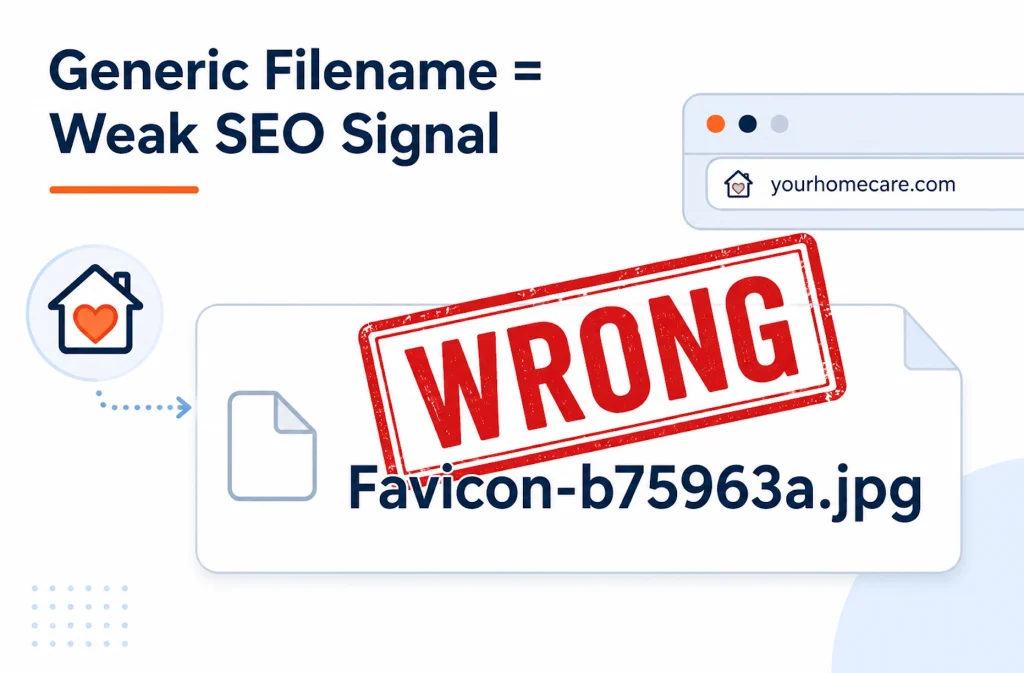
Yes, and it is one of the most overlooked technical SEO moves in home care marketing. Most website platforms save a favicon with a generic filename like favicon.ico or icon-192.png, which wastes a small but real signal Google can read. Naming the file with your brand and a core keyword, something like agetech-marketing-home-care-favicon.png, gives Google another clean, crawlable data point tied to your brand and your service area. Langley Holland, SEO expert and Senior Partner at AgeTech Marketing, treats this as one of the highest-leverage five-minute fixes available to a home care agency. “Your favicon is a secret weapon way too many businesses are not using to their advantage,” Holland says. He points to the favicon as one of the most consistently present and reliably crawled assets on a site, appearing on every single page without exception, which is exactly why its filename is worth getting right. It costs nothing to rename the file correctly. Most agencies just never think to do it.
What Does a Bold, Working Favicon Actually Look Like?
A favicon works when its shape stays legible at 16 pixels, and AgeTech Marketing’s own icon was built around that single rule. It is a bold blue ring wrapped around a solid orange field, with a sharp blue peak cutting through the center that reads at once as the letter A and as a rising line, the same kind of single-shape clarity that makes the Swoosh and the three-pointed star recognizable at a glance. There is no wordmark hidden inside it, and no gradient that disappears when it shrinks to browser-tab size. That is intentional. When we build brand systems for home care clients through our Brand Development work, we test every icon at actual browser-tab size before approving it, because a mark that only looks sharp on a business card is not doing its job where people actually see it most. This same principle applies to any business developing a new logo right now, home care or otherwise: design the icon first, then build the full logo around it, not the other way around.
How Do You Know If Your Agency’s Favicon Needs an Upgrade?
Most agencies never actually chose a favicon. It was auto-generated by a website theme, cropped from a logo file that was never designed for it, or left blank entirely, resulting in a generic browser icon next to the site’s name. Fixing this does not require a full site rebuild, the same principle behind boosting conversions without rebuilding a website, and a new favicon can typically go live in an afternoon. Signs it is time for an upgrade include:
- The icon looks blurry or pixelated in the browser tab, since Google has pushed sites toward sharper, higher-resolution favicons for better visibility in search results
- It is a default icon, a stock house symbol, or the browser’s fallback globe
- It does not use the agency’s actual brand colors
- It is a shrunk-down version of a detailed logo that turns into a smudge at small sizes
Any one of these is worth fixing before the next brand refresh, not after.
Favicon Questions Home Care Agency Owners Actually Ask
Can I just shrink my existing logo down to make a favicon?
You can, but it usually breaks down once the logo drops below about 32 pixels. Logos built with wordmarks, fine lines, or more than two colors turn into a blurry smudge at favicon size. Treat the favicon as its own simple shape, just as Nike and Mercedes-Benz treat their icons as standalone marks rather than shrunken logos.
What size should a home care agency’s favicon be?
Google’s guidelines require only a square image at least 8×8 pixels, but recommend a size larger than 48×48 pixels to ensure it displays clearly across devices and search results. Most agencies are best served by uploading a 512×512-pixel PNG and letting the website generate the smaller sizes automatically.
Will updating our favicon affect our Google rankings?
A favicon is not a confirmed ranking factor in Google’s public documentation, and there is no published study proving that renaming the file moves a listing up or down. Langley Holland, SEO expert and Senior Partner at AgeTech Marketing, treats it as one anyway, based on informed judgment rather than hard proof. His reasoning: a favicon is one of the most consistently crawled pieces of code on any website, since Googlebot reads it on every single page far more often than most other on-page elements, so naming that file with your brand and a keyword instead of leaving it as favicon.ico costs nothing and cannot hurt. What is confirmed is that Google’s own guidance already pushes sites toward sharper, higher-resolution favicons because they affect how a listing is recognized and scanned once it appears in the results, and better recognition can drive more clicks on a listing that is already ranking.
How often should we change our agency’s favicon?
Only when the broader brand changes, since a favicon needs time and consistency to build real recognition. Google’s own guidance also notes that a favicon’s file address should stay stable rather than shift frequently. Treat a favicon update as part of an intentional brand refresh, not something to test or swap on a whim.
Ready to Fix the Details That Actually Get Noticed?
A favicon will not fix a thin referral pipeline or an empty caregiver schedule on its own, but it is one of the fastest, lowest-cost upgrades a home care agency can make to how memorable it looks online, and it is usually one of the first things we check when we start with a new agency. If you want a marketing partner who looks at details like this alongside your SEO, paid ads, and caregiver recruitment, book a 15-Min Intro Call, and we will walk you through how our AgencyGo™ system brings it all together into one coordinated plan.
Related Reading
You may find these articles helpful: