
Somewhere right now, an adult daughter is sitting in a hospital corridor, phone in hand, searching for someone who can be at her mother’s house by Thursday. She’s not typing “home care.” She’s typing “home care agency near Naperville” or “caregiver for elderly in DuPage County.” Whether your agency shows up in that moment is not a matter of luck. It is the direct result of decisions you’ve already made about your SEO strategy.
The agencies scaling in 2026 have figured this out. They’ve stopped chasing broad national terms and started owning the neighborhoods where their clients actually live. Here is how that shift works in practice — and what it takes to execute it.
The Search Behavior That’s Rewriting Home Care Marketing
Broad keyword targeting was never a great strategy for regional home care agencies, but it has become a genuinely losing one. Search results for terms like “home care” are dominated by national directories, large franchise brands, and aggregator platforms that have been accumulating domain authority for a decade or more. Competing directly against that infrastructure is an expensive distraction for a regional operator.
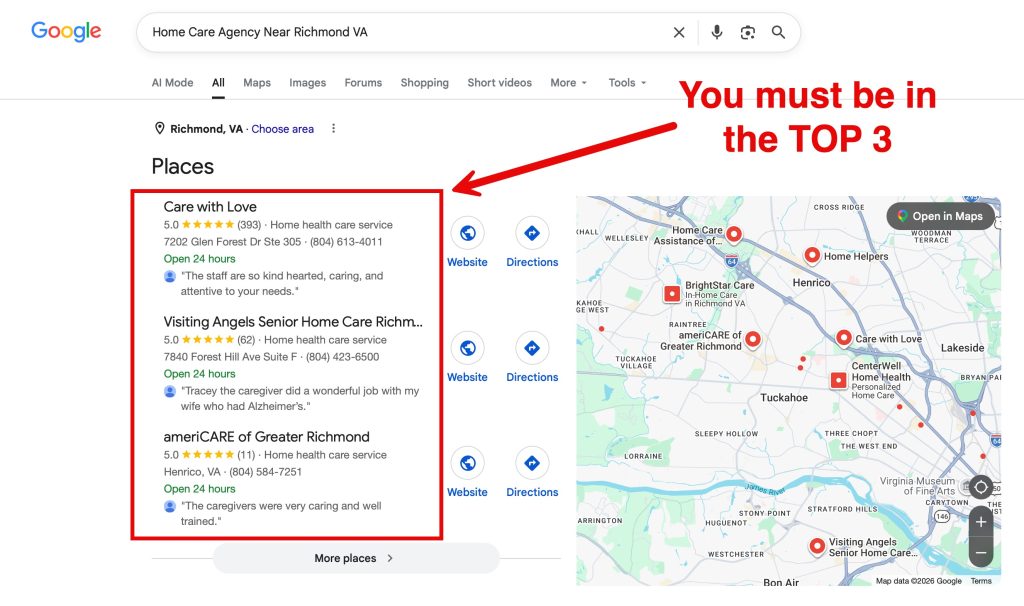
What has changed is the growing dominance of what researchers call crisis-driven local search. When a family suddenly needs in-home care — triggered by a fall, a hospital discharge, or a rapid cognitive decline — the search is urgent and specific. Proximity becomes the deciding variable. Families want someone local, credible, and available now. Google has recognized this pattern and increasingly rewards agencies with a verified, local physical presence in its Map Pack, the three-listing block that appears above organic results.
That structural advantage compounds quickly when you layer in a deliberate review strategy — which is exactly where the most actionable opportunity lies.
Winning the Google Map Pack Through Review Velocity
The Map Pack is the most valuable piece of digital real estate in home care marketing. The agencies sitting in those three spots aren’t necessarily the largest or oldest. They are the ones whose Google Business Profiles (GBP) are well-maintained and whose reviews arrive consistently over time.
An incomplete GBP is a ranking liability from day one. Your profile should carry accurate service area boundaries, consistent NAP data (name, address, and phone number), updated business hours, real staff photos, and correctly selected service categories. Think of it as your digital front door. Every blank field is a missed trust signal sent to both Google and the family comparing you against two other agencies on her phone screen.
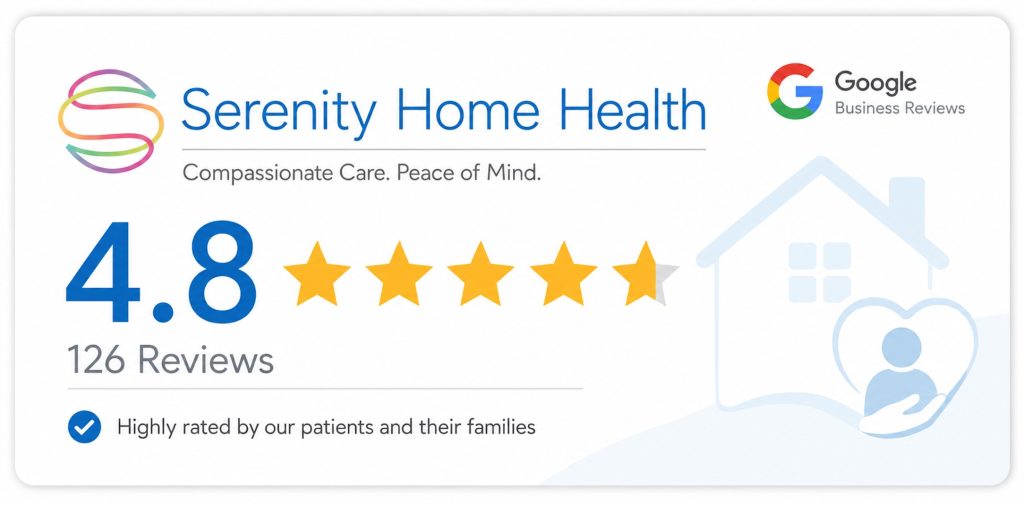
The more nuanced issue is the distinction between total review count and review velocity — the rate at which new reviews arrive over time. Fresh reviews carry more algorithmic weight than older ones. Fifty five-star reviews earned over three years ago tell Google that your agency was trusted then. Ten reviews earned this month tell Google your agency is trusted right now. That distinction matters in the ranking logic.
Building consistent velocity requires a system rather than occasional reminders. A reliable approach is to ask caregivers for internal feedback each week, follow up with client families at 30-day and 90-day care milestones with a simple text or email review request, and automate that sequence through your existing CRM or scheduling software. The effort is modest. The compounding effect on local rankings is not.
The Suburb Strategy: Ranking Where Your Clients Actually Search
The most underused asset in home care agency marketing is the suburb-specific landing page. Franchise brands tend to dominate metro-wide generic searches. But individual neighborhoods are wide open for agencies willing to build content at that level of specificity.
The reasoning is straightforward. A daughter caring for her father in Naperville isn’t searching “home care Chicago.” She’s searching “dementia care near Naperville” or “respite care in DuPage County.” Agencies that build dedicated pages for every suburb and county they serve capture that high-intent traffic directly, while competitors targeting broader terms remain invisible to her.
Research from AgeTech Marketing confirms that service-specific and location-specific combinations consistently outperform generic home care pages in both traffic quality and conversion rate. Keyword targets worth building pages around include combinations like “Alzheimer’s care in [Neighborhood],” “24-hour home care near [City District],” and “senior companion care [Suburb].”
The structure of each page matters as much as the keyword. Original content — referencing local landmarks, specific service availability in that area, and neighborhood-relevant context — is what separates a page that ranks from a page that gets penalized for duplicate content. Simply swapping city names across templated copy provides no value to Google and less to the family reading it.
Long-term ranking authority for these pages depends on more than geography, though. It depends on who is producing the content and whether Google can verify that the source is credible.
Building E-E-A-T: Why Clinical Voice Belongs in Your Content
Home care content occupies what Google classifies as a Your Money or Your Life (YMYL) category — meaning the stakes of inaccurate or low-quality information are high enough that Google scrutinizes authorship and expertise with extra weight. Generic posts credited to “Admin” or “Staff Writer” send the wrong signal entirely.
Google’s E-E-A-T framework — Experience, Expertise, Authoritativeness, and Trustworthiness — rewards content that can be traced back to a credible, qualified human being. For home care agencies, that person is your Registered Nurse, your Director of Care, or your clinical lead.
Author bylines backed by credentials and a short professional bio give Google’s algorithm something concrete to evaluate. Dedicated author profile pages that link back to published articles build a content footprint that compounds authority over time.
This doesn’t require your RN to write every word. A practical workflow is having a marketing coordinator draft the article and having a qualified clinician review, annotate, and sign off before publication. That documented review step is what separates credible home care content from filler. Specificity signals relevance in neighborhoods. Specific authors signal trustworthiness in content.
The “Cost of Care” Guide: Your Highest-Converting SEO Page
Families evaluating home care options don’t begin their search by looking for an agency. They begin by looking for a number. Cost-related search queries are among the highest-intent research questions in senior care because the families asking them are emotionally ready to make a decision and are looking for an agency honest enough to answer directly.
A dedicated page targeting “How much does home care cost in [City]?” captures that intent at the exact moment it matters most. Three keyword clusters worth building this content around are “home care cost in [City],” “long-term care insurance home care coverage,” and “private pay home care rates [City].” Together they cover the full range of how families approach the financial question.
Transparent pricing guides do more than rank. They build trust with families who are vulnerable, skeptical, and comparing multiple agencies. Publishing honest cost ranges — even when the numbers are sobering — signals the kind of credibility that vague agency websites cannot replicate.
The most useful version of this guide addresses both long-term care insurance and private pay options in the same piece, since most families don’t yet know which path applies to their situation. Walk through how insurance claims typically work, what private pay generally covers, and what questions families should ask any agency they consider. Close the page with a single, low-pressure call to action: a free care consultation or a downloadable cost worksheet. Families who finish reading deserve a comfortable next step.
Technical SEO: Speed Is a Frontline Conversion Tool
Most adult children are searching for care on a mobile device in a high-stress environment — a hospital waiting room, a parking lot between meetings, a late-night kitchen table moment. That context means your website’s technical performance is not a backend concern. It is a frontline variable that determines whether a family stays on your page or clicks to a competitor.
If your pages don’t load within 2.5 seconds on mobile, you have likely already lost that visit. Google’s Core Web Vitals, and specifically the Largest Contentful Paint metric, factor directly into search rankings. Baseline fixes include compressing images, eliminating render-blocking scripts, and leveraging browser caching.
Beyond load speed, implementing LocalBusiness and Service schema markup allows search engines to surface your location, hours, and services directly in results before a family even clicks through. Mobile layout details — thumb-friendly tap targets, click-to-call phone numbers, intake forms limited to three fields — remove friction at the moment families are ready to act.
Hospital discharge planners are a frequently overlooked audience in this context. Social workers searching for same-day placement options on a hospital tablet have zero tolerance for sluggish pages. Speed serves every visitor, but it specifically serves the ones who matter most in home care: families in motion and under pressure.
Building Authority Through the Senior Living Ecosystem
Content alone does not build domain authority. The backlinks and directory listings pointing to your site determine how much trust search engines assign to everything you publish.
Local hospitals, senior centers, and community health organizations regularly maintain resource pages for families navigating care decisions. A single link from a regional hospital’s “community resources” page carries more SEO weight than dozens of generic directory submissions. Earning those placements typically requires outreach, relationship-building, and genuine community involvement — sponsoring a senior wellness fair, contributing to a neighborhood newsletter, or partnering with a memory care support group.
Niche directories occupy a distinct layer in this ecosystem. Platforms like Caring.com and A Place for Mom consistently rank at the top of Google for competitive senior care searches. Because they often outrank individual agencies, a fully completed, photo-rich profile with active reviews on these platforms is not optional. Treat each profile as a landing page rather than a citation.
Together, directory presence, institutional backlinks, and community partnerships form the authority layer that makes every other tactic in your strategy perform better.
The Five-Point Home Care SEO Blueprint for 2026
As Langley Holland, founder of AgeTech Marketing, puts it: “SEO for home care is about proving you are the local expert before the family even picks up the phone.” These five actions are designed to do exactly that.
Claim and fully optimize your Google Business Profile through SEO Services best practices — upload real staff photos, complete every field, and select precise service categories. Build suburb-specific landing pages for every neighborhood you serve, combining location with specific service terms to capture high-intent searches. Publish a transparent cost-of-care guide that walks families through both insurance and private pay options with regional pricing context. Automate your review request process so that satisfied families are consistently and promptly invited to share their experience.
Finally, have all medical or clinical content reviewed and signed off by a licensed professional before publication. Google’s helpful content standards treat home care as a YMYL category, and professional authorship protects both your rankings and your agency’s reputation.
Putting the Strategy to Work
Home care SEO delivers compounding returns. The challenge most agency owners face is not understanding what needs to be done. It is finding the capacity to do it consistently while running a care operation that demands full attention on staffing, compliance, and quality.
AgeTech Marketing was built specifically for this problem. As a division of seelutions, a digital marketing agency with roots back to 1983, AgeTech brings decades of SEO and brand development experience to the unique dynamics of the senior care market. The team understands the trust signals that matter in home care, the language families use when searching at 11 p.m., and the hyper-local variables that move rankings in mid-size metros.
The full range of services available through the AgencyGo™ system includes Brand Development, SEO Services, Website Optimization, Paid Advertising, Social Media Marketing, and Employment Branding — each one designed to integrate into the operational rhythm of a home care agency rather than create additional burden.
If scaling in 2026 is the goal, the logical starting point is an honest audit of where your hyper-local SEO currently stands. Not a six-month content plan built on assumptions, but a clear look at what is working, where rankings are leaking, and which neighborhoods represent your fastest growth opportunity. Reach out to AgeTech Marketing today to request your strategy audit.
Frequently Asked Questions
What is hyper-local SEO for home care agencies?
Hyper-local SEO focuses on optimizing your agency’s online presence to rank prominently in search results within specific neighborhoods, suburbs, and zip codes where your clients live. Rather than targeting broad metro-area terms, hyper-local strategies use suburb-specific landing pages, a fully optimized Google Business Profile, and location-paired service keywords to capture high-intent searches from families looking for care close to home.
How long does it take to see results from home care SEO?
Most agencies begin to see measurable improvements in local search visibility within three to six months of consistent implementation. Google Business Profile optimization and review velocity work faster than content-based rankings, which typically require six to twelve months to fully compound. The timeline accelerates significantly when technical SEO fundamentals are already in good shape.
Why do home care agencies need E-E-A-T content?
Home care falls under Google’s Your Money or Your Life classification, meaning the platform holds health-related content to a higher standard of demonstrated expertise. Content attributed to named, credentialed authors — particularly licensed clinical staff — performs better in rankings and builds more trust with families evaluating care options. Anonymous posts carry real ranking risk in this category.
What should a suburb landing page include?
An effective suburb landing page needs original written content specific to that location, references to local geography or community context, clear service availability details, a service-location keyword combination in the page title and headers, and a direct call to action. Pages that simply swap city names across a shared template provide no SEO value and risk duplicate content penalties.
Is paid advertising necessary if SEO is working well?
SEO and paid advertising serve different functions in a home care growth strategy. SEO builds compounding organic authority over time, while paid advertising through platforms like Google Ads delivers immediate visibility for specific services or locations. Agencies at different growth stages benefit from different mixes. A strategy audit is the most reliable way to determine where paid advertising adds the most value relative to your current organic footprint.
How does AgeTech Marketing differ from a general digital marketing agency?
AgeTech Marketing focuses exclusively on the home care and senior care market. That specialization means the team understands the trust dynamics of care decisions, the search language families use in crisis moments, and the local authority signals that matter in markets like Richmond and similar mid-size metros. Generic digital agencies rarely have that context, which leads to slower results and costly trial-and-error approaches.
Got 20 Minutes? Let’s Talk Growth.
Contact Langley Holland, (757) 693-7374 or boom@agetechmarketing.com
This post contains a mix of original and AI-generated imagery. AI-created images were produced using ChatGPT and may not reflect real people, places, or events.