
Yes, if your website has not been checked for accessibility barriers, it can expose your home care agency to a real legal claim under the Americans with Disabilities Act, regardless of how small your agency is. Federal courts treat websites as places of public accommodation, the same legal category as your office, and plaintiffs’ firms have turned that interpretation into a high-volume litigation business.
Most home care agency owners have never heard of this risk until a demand letter shows up, and it rarely comes up in a conversation about marketing even though it can cost far more than a year of SEO or ads. In 2025, plaintiffs filed 4,928 web accessibility lawsuits in federal court, according to UsableNet’s 2025 Year-End Digital Accessibility Lawsuit Report, continuing a multi-year climb in this kind of litigation. This is not a risk limited to national retailers. A home care agency’s website almost always includes an online intake form, a caregiver job application, or a request-a-consultation form, which are exactly the kinds of interactive elements that trigger these claims. Here is what actually causes them, what a compliant site requires, and what to do if a letter lands in your inbox.
Can a Small Home Care Agency Really Get Sued Over Its Website?
Yes, small businesses are sued over website accessibility constantly, and Title III of the ADA contains no small business exemption. The Department of Justice’s guidance on ADA.gov treats privately operated businesses open to the public, including their websites, as places of public accommodation that must be accessible to people with disabilities. Plaintiffs’ firms specifically target smaller operations because they tend to have more compliance gaps and a stronger incentive to settle quickly rather than fight a federal case. A home care agency with an outdated website is a more attractive target than a large hospital system with in-house legal counsel, not a less likely one, and the irony of a company serving seniors and people with disabilities getting flagged for an inaccessible site is not lost on the plaintiffs’ bar.
What Triggers an ADA Website Accessibility Lawsuit Against a Home Care Website?
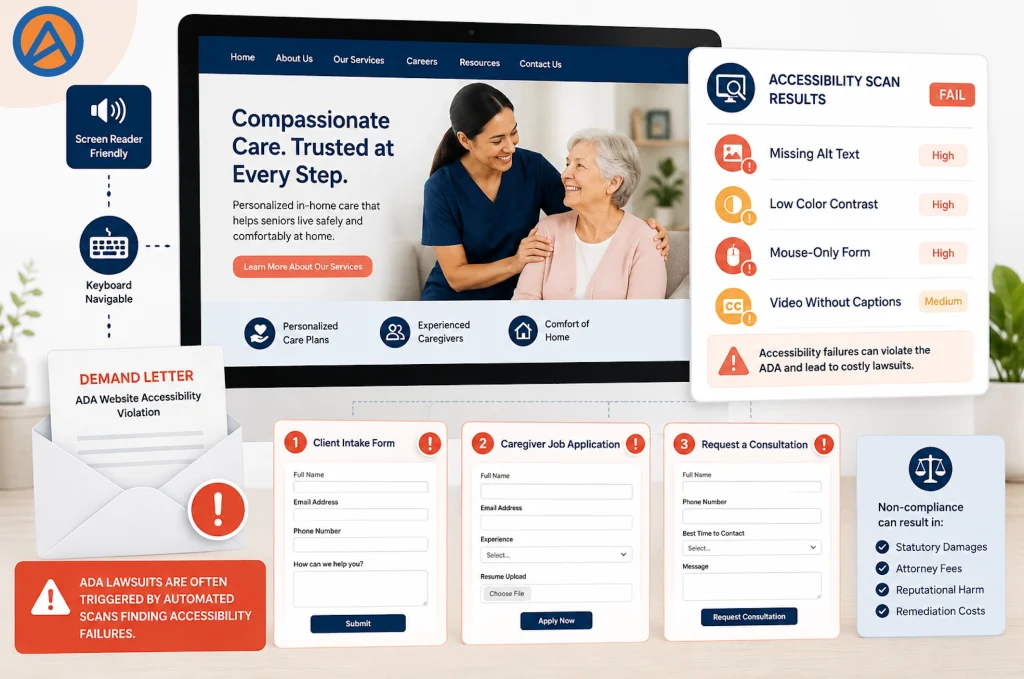
Lawsuits are typically triggered when a screen reader or accessibility scan cannot properly navigate a site, most often due to missing image alt text, forms that cannot be completed without a mouse, low color contrast, or video without captions. For a home care agency, the highest-risk pages are usually the client intake form, the caregiver job application, and the request-a-consultation form, since these are the interactive elements automated scanning tools flag first. Plaintiffs’ firms run these scans across thousands of sites at once, then send a templated demand letter to each one that fails. A quick patch after a first letter is rarely enough if the underlying code problems remain, since it leaves the agency exposed to being sued again by a different firm.
What Does a Compliant Home Care Website Actually Require?
A defensible website generally needs to meet the Web Content Accessibility Guidelines at Level AA, the technical standard courts and the DOJ consistently reference. The W3C’s WCAG 2.2 standard, maintained by the Web Accessibility Initiative, covers areas like text alternatives for images, keyboard-only navigation, sufficient color contrast, resizable text, and properly labeled form fields, which matters enormously for a caregiver application or client intake form that needs to actually be completable without a mouse. This is not a design preference, it is a published technical benchmark a developer can test a site against directly. Meeting WCAG 2.2 AA does not make an agency lawsuit-proof, but it removes the obvious, easily-scanned violations that make up the overwhelming majority of demand letters in the first place.
How Much Does an ADA Demand Letter Actually Cost a Home Care Agency?
Most cases begin with a demand letter asking for a settlement, and research compiled by Accessible.org shows settlement demands commonly fall between five thousand and twenty five thousand dollars, with out-of-court settlements that proceed further averaging around thirty thousand dollars and sometimes reaching well over a hundred thousand. For a home care agency running on thin private-pay margins, a single demand letter can represent a larger unplanned expense than an entire year’s marketing budget. Many owners are also surprised that general liability insurance rarely covers this kind of claim without a specific cyber or media liability rider added ahead of time, which is why a partial audit and fix of the intake and application forms is almost always cheaper than waiting for the letter to arrive.
Do Accessibility Widgets Actually Protect a Home Care Agency’s Website?
No, overlay widgets that claim to make a site instantly compliant do not reliably fix the underlying code and frequently do not hold up as a legal defense. UsableNet’s accessibility research has found that overlay widgets typically fail to resolve code-level issues and can even interfere with the assistive technology, like screen readers, that they claim to support. Courts have increasingly treated overlay-only fixes as evidence a business knew about its obligations but chose a shortcut instead of genuine remediation, a particularly bad look for an agency whose client base skews toward older adults and people managing a disability. A widget can be one small part of a broader effort, but it cannot replace an actual audit of a site’s code, structure, and forms.
What Should a Home Care Agency Do First to Reduce Its Risk?
Start with the highest-impact, lowest-effort fixes rather than trying to solve everything at once.
- Run an automated accessibility scan to catch obvious issues like missing alt text and poor color contrast.
- Test your intake form, caregiver application, and consultation request form using only a keyboard, no mouse.
- Add an accessibility statement describing your commitment and ongoing remediation efforts.
- Prioritize fixes on your homepage, contact page, and any page tied to intake or hiring, since those are the pages plaintiffs’ scans most often flag first.
- Document every fix and audit date, since a documented good-faith effort matters if a claim does arise.
- Train whoever adds new content to your site, since a single new blog post or caregiver bio with unlabeled images can quietly reintroduce a violation months after your last audit.
If you are unsure where to start, our team walks through this exact process as part of Website Optimization for home care agencies, and it pairs naturally with the broader conversion work most agencies already need on the same pages. Agencies that have already streamlined how families and caregivers move through their online intake process usually find the accessibility fixes fold in with far less disruption than starting from scratch.
FAQ: Home Care Agency Owners Ask About ADA Website Compliance
Do I need to hire a lawyer if I get an ADA demand letter?
Yes, you should involve an attorney experienced in ADA Title III claims before responding to any demand letter, since the response itself can affect your legal exposure. This article is not legal advice, and a qualified attorney should review your specific situation.
Does my website builder, like WordPress or Squarespace, make my site automatically compliant?
No, no website platform is automatically ADA compliant out of the box, though some templates start with fewer accessibility problems than others. Compliance depends on how your specific site is built, including image alt text, form labeling, and navigation structure, not just the platform underneath it.
How often do I need to re-check my site for accessibility?
Accessibility is ongoing, not a one-time fix, since every new page, caregiver bio, or job posting you add can reintroduce a barrier. Most agencies benefit from a full audit annually and a lighter check any time significant new content or a new intake form goes live.
Is this really a risk for a small local agency, or mostly big companies?
It is a real risk for agencies of any size, and home care specifically draws attention because so many sites rely on forms, whether that is a client intake form, a caregiver application, or a scheduling request. Automated scanning tools do not distinguish between a large chain and a single-location independent agency.
Protect Your Home Care Agency Before the Letter Arrives
An accessible website is good practice for every visitor and a meaningful shield against a lawsuit that can cost far more than the fix. AgeTech Marketing builds and audits home care websites with accessibility in mind from the start, and AgencyGo™ includes a website review as part of getting your marketing foundation right before you spend another dollar on ads or SEO. Book a 15-minute intro call and we will give you a straight answer on where your current site stands.
You may find these articles helpful: Why Hyper-Local SEO Is the Only Way to Scale Your Home Care Agency in 2026 and The Human Element: Why AI Can’t Replace Personal Connection in Home Care Marketing.
This article reflects AgeTech Marketing’s professional experience working with home care agencies across the country and is intended for general informational purposes, not legal advice. Consult a qualified attorney regarding any specific ADA compliance question or demand letter, and no agency can guarantee immunity from legal claims.