
Most home care agency owners have no idea whether their agency shows up when a family asks ChatGPT for a home care recommendation or triggers a Google AI Overview instead of a normal list of blue links. That blind spot has a real cost, because AI assistants have become a genuine referral channel for families researching care, and if your agency isn’t part of the answer, a competitor’s is.
What Is AI Search Visibility, and Why Does It Matter for Home Care Agencies?
AI search visibility is when tools like ChatGPT, Google AI Overviews, and Perplexity mention or recommend your agency when someone asks a care-related question, separate from whether you rank on a traditional Google results page. It matters because these tools now answer the question directly instead of sending the user to a list of websites to click through themselves. A family member researching care for an aging parent might ask, “What should I look for in a home care agency near me?” and get a synthesized answer that names two or three specific providers. If your agency isn’t one of the names mentioned, that lead never reaches your site, your phone, or your contact form. You lose the client before you ever knew they were looking, and you never get the chance to explain why your agency was the right fit.
How Many Families Are Actually Using AI Tools to Search for Home Care?
A meaningful and fast-growing share of families now start their research with an AI tool instead of a traditional search. Pew Research Center found that 34 percent of U.S. adults had used ChatGPT as of 2025, roughly double the share who had used it in 2023, with usage highest among adults under 30, the age group most likely to be researching care for an aging parent. Separately, Semrush’s analysis of more than 10 million keywords found that Google AI Overviews appeared in just 6.49 percent of tracked search queries in January 2025 and climbed to nearly 25 percent by July 2025. Adult children searching for care for a parent are exactly the demographic driving this shift, and every month more of them see an AI-generated answer before they ever land on your website.
How Is AI Search Different From Ranking on Google?
Traditional SEO earns a position on a results page and depends on the searcher clicking through to your site to learn anything about you. AI search visibility, often called generative engine optimization, is when an AI system trusts your content enough to summarize, cite, or name your agency directly inside its answer, with no click required. The two are related but not identical. A page that ranks well on Google because of strong backlinks and technical SEO won’t automatically get cited by an AI assistant if the actual content is vague, buried under marketing language, or doesn’t clearly answer the question being asked. AI systems pull from content that states things plainly: direct answers, named facts, and clear structure. Agencies that have invested in hyperlocal SEO already have a head start, since much of that groundwork, like structured local content and consistent NAP data, also supports AI citation.
What Makes an AI Assistant Recommend One Home Care Agency Over Another?
AI assistants tend to cite pages that answer a specific question in the first sentence or two, back claims with named sources rather than vague statements, and clearly show who is behind the content and why they’re credible. Pages buried in generic marketing copy, or written to satisfy a keyword instead of a real question, rarely get pulled into an AI-generated answer. This means your website content, blog posts, and even your Google Business Profile description need to read like direct, honest answers to the exact questions families are typing or asking out loud. It also means credibility signals matter: reviews, licensing information, years in business, and clear service area details all help an AI system trust your agency enough to name it. None of this replaces the relationship-building that actually closes a client once they call, which is still where the human connection in home care marketing does its work.
Is AI Search Visibility Worth It for a Small, Independent Home Care Agency?
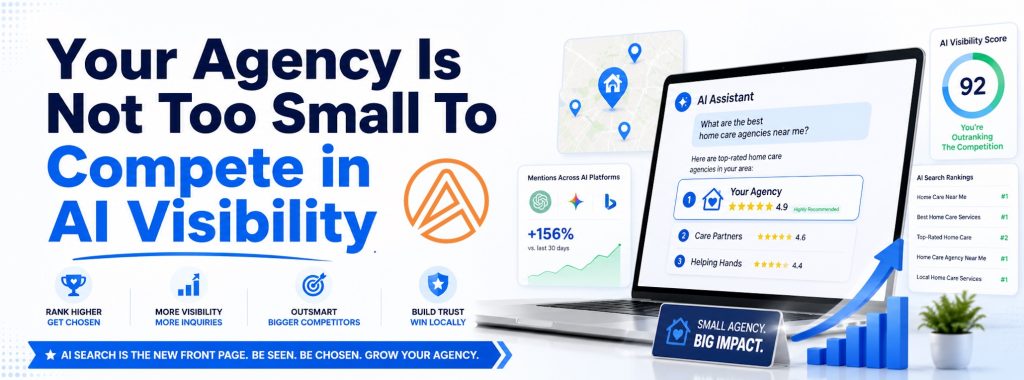
Yes, and arguably more so than for large franchise brands, because AI visibility currently rewards specific, well-organized, locally credible content over sheer brand size. A national franchise with a generic corporate website often loses to a smaller agency whose content directly and clearly answers local questions, since AI systems are optimizing for the best answer, not the biggest budget. This is a rare window where an independent agency with a modest marketing budget can compete on equal footing with a name-brand competitor, provided the content is structured the way AI systems actually read it. Waiting until every competitor has already claimed this space makes it harder to catch up later, since AI systems tend to keep citing sources they’ve already learned to trust. Agencies that treat this as optional right now are handing an advantage to whoever moves first.
Where Should a Home Care Agency Start With AI Search Visibility?
Start by auditing whether your own site and blog content actually answer the specific questions families ask, in plain language, near the top of the page rather than several paragraphs in. From there, prioritize these steps:
- Rewrite key service pages so the first sentence directly answers the core question a visitor came to ask.
- Add a genuine FAQ section to your most important pages using the real language families use, not marketing terms.
- Keep your Google Business Profile, reviews, and service area listings accurate and consistent, since these feed both traditional SEO and AI citation.
- Publish new content regularly enough that AI systems recognize your site as an active, trustworthy source.
None of this replaces solid local SEO or a well-converting website. It builds directly on top of both, and it works fastest for agencies that already have that foundation in place.
Frequently Asked Questions
Does my home care agency need a separate strategy for ChatGPT versus Google?
No, you need one strategy built on the same foundation: clear, honest, well-structured content that directly answers real questions. The same content that earns strong Google rankings, when written to state answers plainly and back up claims with named sources, is what AI assistants pull from when generating their own answers.
Will AI Overviews and chatbots eventually replace my agency’s website traffic entirely?
It’s unlikely to eliminate traffic, but it is already reducing the number of searchers who click through before getting an answer. Your website still matters for the families who want to verify your credibility, read reviews, or make first contact, which is why appearing inside the AI-generated answer itself has become just as important as ranking on the page.
How long does it take to start showing up in AI-generated answers?
There’s no fixed timeline, since it depends on your current content quality, site authority, and how competitive your local market is. Agencies that already have a strong local SEO foundation tend to see AI citations improve faster once content is restructured to directly answer real questions.
Can a small agency really outrank a national franchise in AI search results?
Yes, because AI systems prioritize the clearest, most specific, most locally credible answer over brand size or ad spend. A well-documented independent agency with direct, honest content routinely gets cited over a generic franchise page that never actually answers the question being asked.
You May Find These Articles Helpful
Home Care Website Conversion Without Rebuilding It
Google Ads vs. APFM: Which One Actually Grows Your Home Care Agency in 2026?
Ready to Show Up Where Families Are Actually Looking?
Getting cited by AI assistants isn’t separate from your marketing; it’s the next layer built on solid SEO work. If you want a clear read on where your agency stands in AI search results today, book a 15-minute intro call, and we’ll walk you through how AgencyGoTM handles this alongside the rest of your local market strategy. Book your 15-minute intro call here.
This article reflects publicly available industry data as of July 2026. AI search behavior and platform features change quickly, and agencies should verify current best practices before making major marketing decisions.